


 title="Metal Luggage 8012" alt="Metal Luggage 8012">


Aluminium Luggage Manufacturer: Ready-Stock Cases and OEM Programmes
Smarter Luggage has been building luggage in Dongguan since 2000, and aluminium has been part of that range for most of it. What makes metal luggage different from a plastic programme is that the shell is formed and finished rather than moulded, and that the colour comes from an anodizing line rather than a paint shop. Both of those steps happen in our own plant, which is why we can hold aluminium models in stock and still quote custom builds on the same tool.
The range on this page runs from 17-inch cabin cases to 30-inch check-in, in two material families: 100% aluminium alloy shells, and titanium stainless steel. Model 8012 is the entry point, and it is the case this page is written around.
The 8012 at a glance
The 8012 is a 20-inch cabin case built on a fixed tool and made to order. There is no stock holding on this model, so every order is a production run that starts at the MOQ.
| Item | 8012 |
|---|---|
| Shell | 100% aluminium alloy, bend formed, corner fittings riveted |
| Closure | Aluminium frame, two latches |
| Lock | TSA combination lock |
| Corners | Corner protection |
| Handle | ABS handle |
| Size | 20 inch (the only size on this tool) |
| MOQ | 300 pcs |
| Availability | Made to order, no stock holding |
Two ways an aluminium shell is formed
Not every aluminium case is built the same way. The construction decides where the joints sit, how the edge reads, and what a buyer can change later. We build the two described here: bend forming and frame assembly. Other constructions — casting the shell as a single piece among them — we do not currently offer.
One clarification before the detail: shell forming is not the same question as the frame closure. Every model on this page closes on an aluminium frame. What follows is about how the shell body itself is made.
Bend forming — 8012
The aluminium sheet is cut flat to the developed blank, bent into a three-dimensional shell, fitted with corner pieces and finished with an edge strip. It is a forming process rather than a casting one, and that is where the cost and lead-time advantage comes from.
| Step | What happens |
|---|---|
| 1. Laser cutting | The aluminium sheet is laser cut into the flat blank profile, including the corner notches. |
| 2. Roll bending | The blank goes through a roll bender and is curved into the three-dimensional shell shape. |
| 3. Corner riveting | Corner fittings are riveted into the notched corners, closing the shell at each angle. |
| 4. Edge trim | The edge strip is fitted last, which finishes the opening line the frame closes on. |
Compared with casting a shell as a single piece, this route gives better cost control and higher output, which is why it is the construction we specify for mid-range programmes where the surface finish matters but the tooling budget does not stretch to a cast body.
Frame assembly — 6015
The 6015 is built the other way round: the strength comes from an extruded aluminium frame, and the panels are assembled onto it. The frame is made from aluminium billet, not from sheet.
| Step | What happens |
|---|---|
| 1. Extrusion | Aluminium billet is heated and pushed through a die to produce the profile. |
| 2. Cutting | The extruded profile is cut to the length each part of the case requires. |
| 3. Frame build | The cut sections are assembled into the body frame and the edge of the case. |
| 4. Panel assembly | Aluminium panels are combined with the frame into the finished shell. |
This is the construction that produces a high-strength skeleton with panels hung on it. The 6015 runs a 1.2 mm aluminium plate and weighs 4.4 kg in 20 inch, and the joint lines and rivet pattern stay visible on the outside — part of why it gets specified when the case has to read as a hard case from across a shop floor.
Where the colour comes from: the anodizing department
Anodizing is not a coating. The aluminium surface is converted into an oxide layer and the colour is sealed into that layer, so the finish is part of the metal rather than something sitting on top of it. It does not chip at the corners the way paint does, and it does not lift at an edge.
We run the anodizing department in-house, alongside the shell line. That matters practically: colour approval, re-runs and small batch deviations are handled in the same building as the shells, instead of being sent out and re-scheduled. It is also why a buyer can ask for a colour sample and have it checked against the actual production bath rather than against a printed swatch.
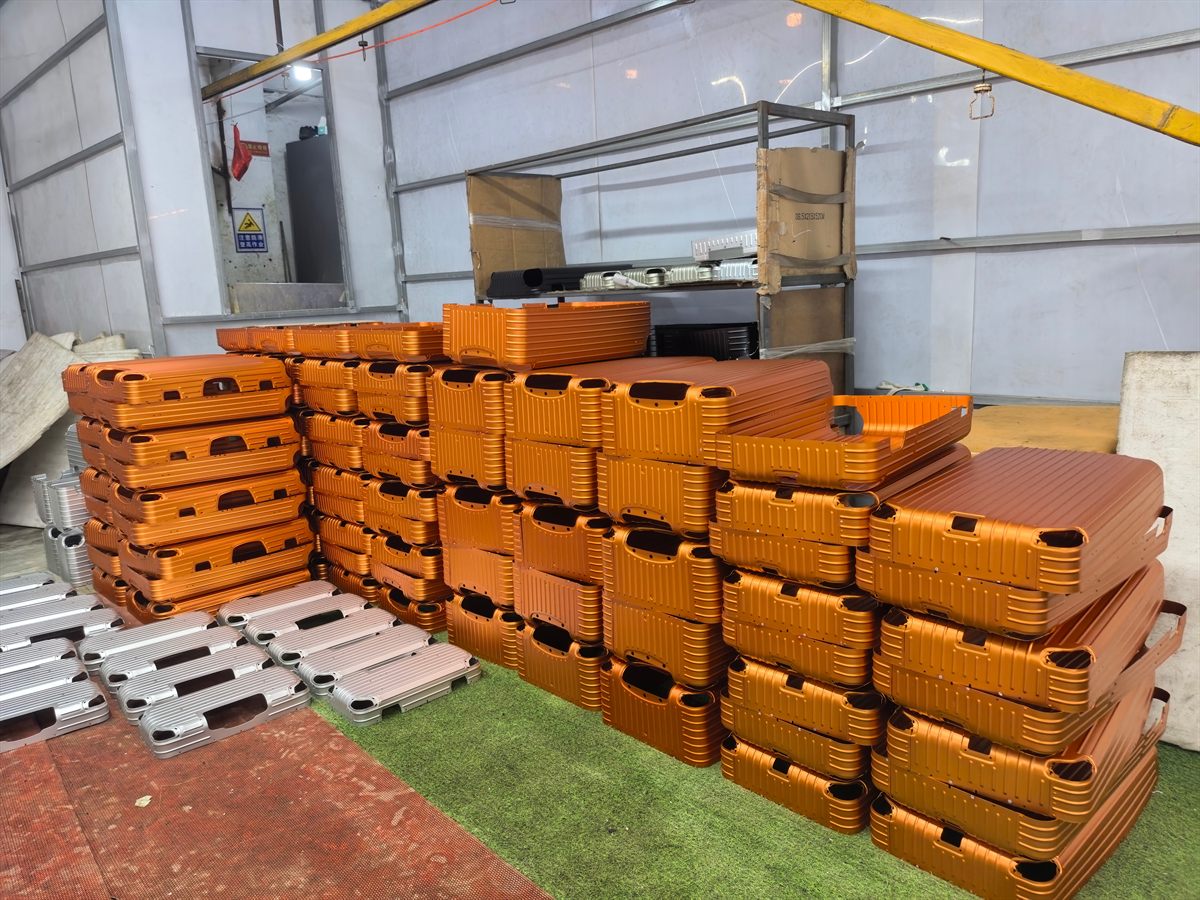
Aluminium shells after anodizing, in the colour bath run at the Dongguan plant.
Standard colours across the range are black, mocha brown, red, silver and gun colour. Other colours are a tool-and-bath question rather than a paint match, so they are scoped per project.
Ready-stock aluminium models
These models are held in stock and can be shipped on a wholesale order without a tooling cycle. All are 100% aluminium alloy with an aluminium frame closure, a TSA lock, an aluminium trolley system, an auto-rebound handle and mute spinner wheels; the differences are the lining, the size set and the front detail. Model 8012 is not part of this stock list — it is made to order.
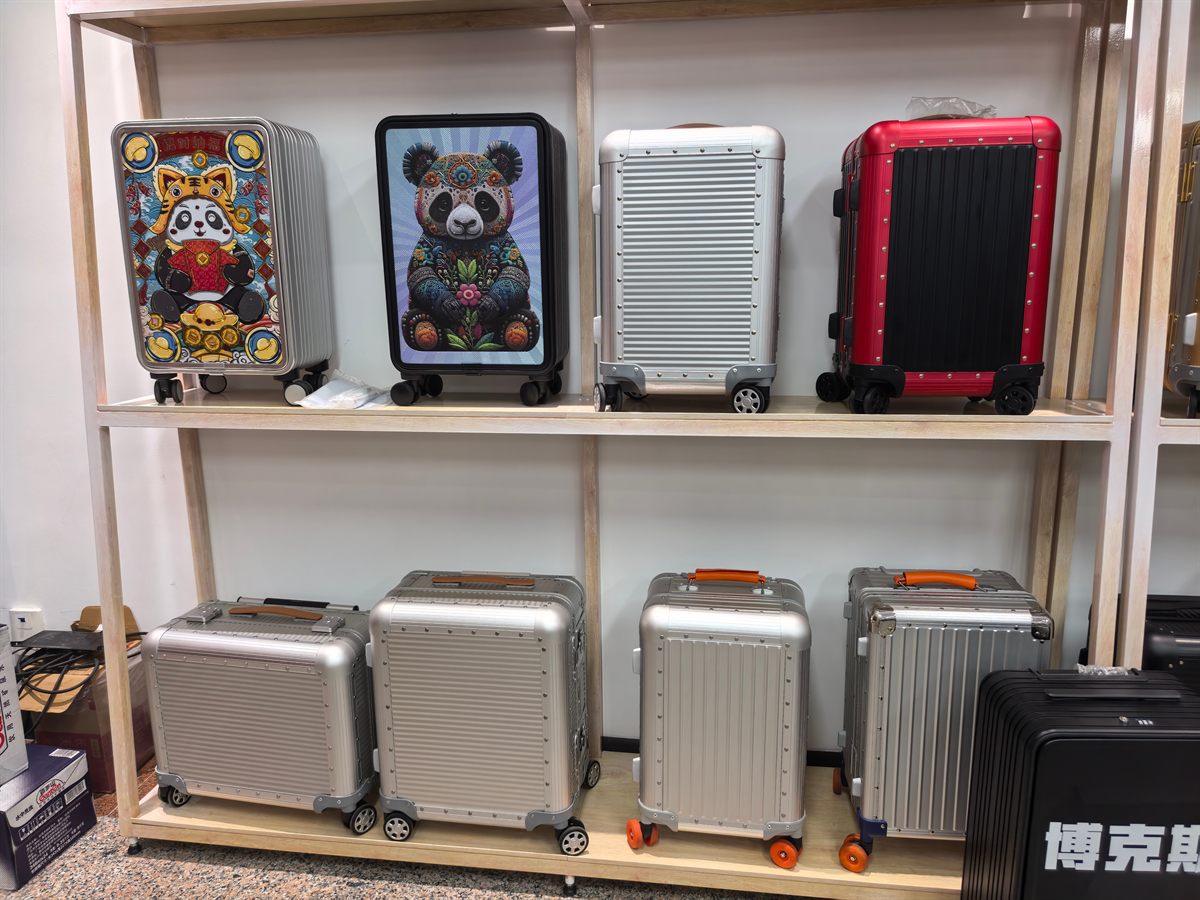
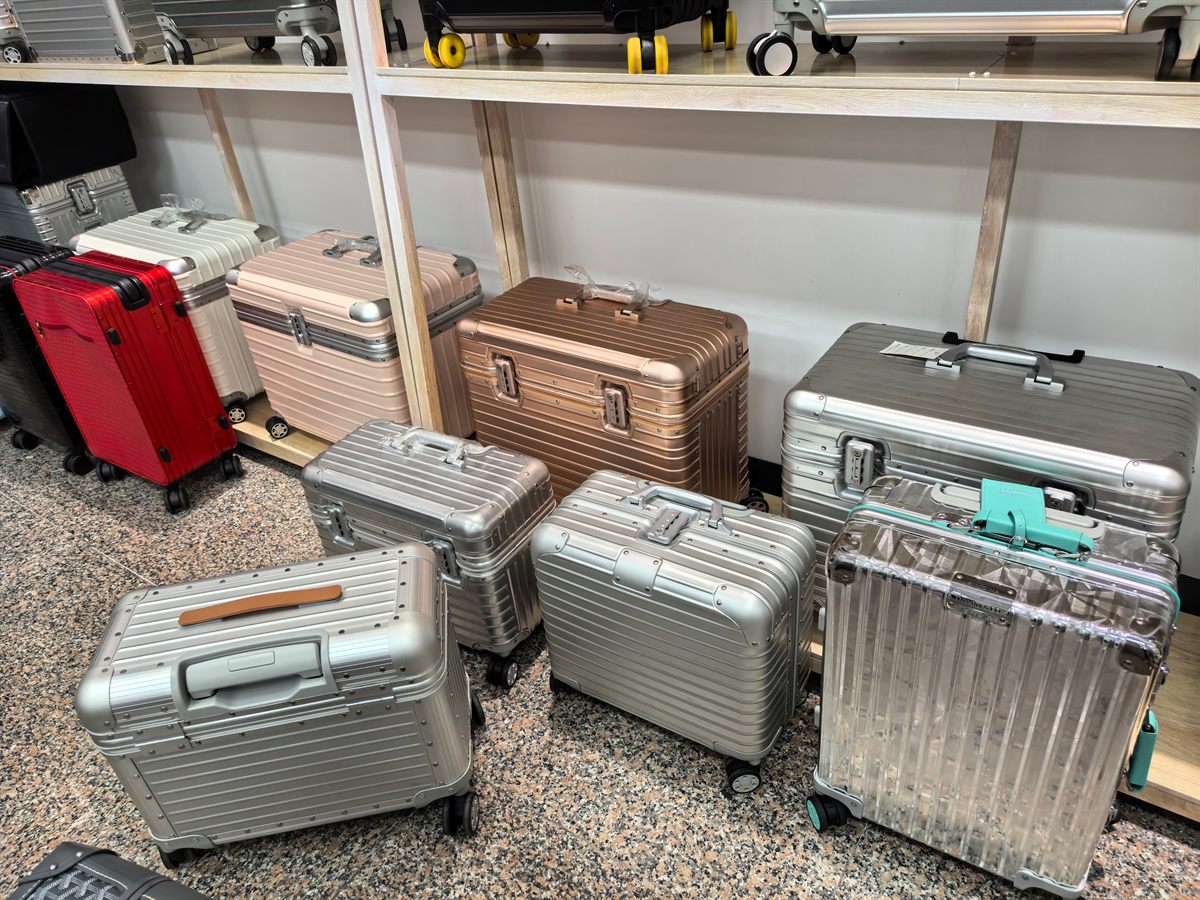
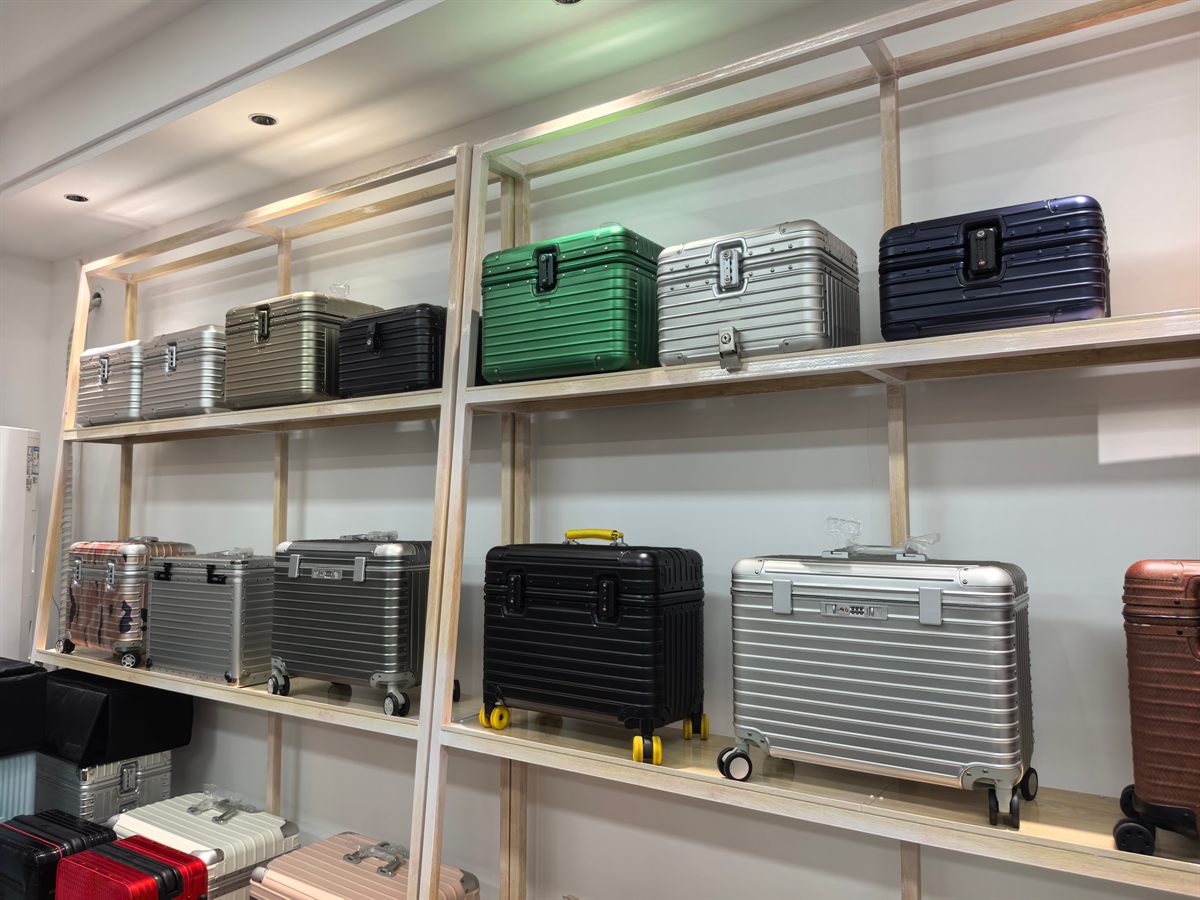
Sample room: ready-stock aluminium models, including frame cases, a front-opening case and the anodized colour range.
| Model | Sizes in stock | Lining | Distinguishing feature |
|---|---|---|---|
| 1020H | 20 / 24 / 28 inch | 230D peach skin satin | Standard frame case |
| 1801 | 20 / 24 / 26 / 28 inch | 210D polyester | Widest size set in polyester lining |
| 1805 | 20 / 24 / 26 / 28 inch | 230D peach skin satin | Standard frame case |
| 1808 | 20 / 24 / 28 inch | 230D peach skin satin, dry and wet separation | Split lining |
| 1809 | 20 / 24 / 26 / 28 inch | 230D peach skin satin | Standard frame case |
| 1870 | 20 / 24 / 26 / 28 inch | 230D peach skin satin, dry and wet separation | Split lining |
| 1880 | 20 / 24 / 28 inch | 230D peach skin satin, dry and wet separation | Split lining |
| 1908 | 20 / 24 / 26 / 28 inch | 230D peach skin satin, dry and wet separation | Split lining |
| 8019 | 17 / 20 / 24 inch | Silk touch peach skin satin | Front-opening design, SJ mute spinner wheels |
Other aluminium builds in the range
These are aluminium as well, but built differently: a front pocket, a heavier plate, a smaller cabin size, or a different handle set. They are the models to look at when 8012 is the right material but the wrong shape.
| Model | Size | Shell | Weight | Distinguishing feature |
|---|---|---|---|---|
| 6015 | 20 inch | 100% aluminium alloy, 1.2 mm plate, frame assembly | 4.4 kg | Silk touch peach skin satin lining, aluminium closure, soft handle |
| 9015 | 20 / 24 / 30 inch | 100% aluminium alloy | — | PU handles, silent rubber wheels |
| 1890 | 20 / 24 inch | 100% aluminium alloy | — | Front-open pocket, silent wheels |
| GDF-008 | 20 inch | Aluminium with microfibre | 5.6 kg net, 6.8 kg gross | 35 L capacity, Dacron lining |
| 98520# | 20 inch | Aluminium | 4.0 kg | Satin poplin lining, German brand spinner wheels |
| 687301# | 18 inch | All aluminium | 2.2 kg | Satin poplin lining, six colours |
| 6089# | 18 inch | All aluminium | 4.1 kg net, 5.2 kg gross | 210D lining, black only |
Titanium stainless steel models
For programmes where the shell has to read as a different material class at retail, the titanium stainless steel group uses a harder shell surface and a heavier, warmer finish than straight aluminium. All four are 20 inch except the GDF-16-6H, which is built in two sizes.
| Model | Size | Capacity | Weight | Colours |
|---|---|---|---|---|
| GDF-006T | 20 inch | 38 L | 4.5 kg net, 6.2 kg gross | Silver, black, blue, golden |
| GDF-006TP | 20 inch | 38 L | 4.5 kg net, 6.2 kg gross | Silver, black, blue, golden |
| GDF16-17 | 20 inch | 38 L | 4.5 kg net, 6.2 kg gross | Silver, black, blue, golden |
| GDF-16-6H | 20 / 24 inch | — | — | Silver, black, blue, golden |
Trolley, wheels and locks
The components that decide whether an aluminium case survives a season of handling are the trolley, the wheels, the lock and the hinges. Our component supply includes HINOMOTO wheels, YKK zips and YIF locks, and a trolley supplier that also supplies Samsonite. Locks across the aluminium range are TSA combination locks, so the case can be inspected without being forced.
Because the frame closure carries the load instead of a zip, the hinges and latches are the wear points to specify first. On a frame case these are metal, matched to the frame, and inspected with it.
What can and cannot be changed on the 8012
This is the part buyers most often get wrong, so it is worth stating plainly. The 8012 is built on a fixed tool. Customisation on this model is limited to the lining. If your programme needs a different shell, a different size, different hardware, different wheels or a different trolley, that is a new development with its own tool, not a variant of this case — say so at enquiry stage and we will scope it as a separate project.
| Item | 8012 |
|---|---|
| Lining material | Open to your specification |
| Branding | UV printing, laser marking on the shell, laser marking on the trolley |
| Shell, frame, hinges | Fixed by the tool |
| Wheels, trolley, handle | Fixed by the tool |
| Size | 20 inch only |
Branding on a fixed-tool model
Marking is a finishing step, not a tooling one, so it sits outside the boundary above. Three routes are available across the aluminium range: UV printing, laser marking on the shell, and laser marking on the trolley. None of them requires a new tool or a change to the shell specification, and all three are add-on costs quoted per piece against your artwork.
Laser marking on aluminium is made in the metal rather than applied to it, so it does not lift at an edge the way a printed label can. Send the artwork as a vector file and we will confirm the marking position on a sample before the run.
MOQ, ready stock and sampling
Two order routes sit side by side, and the minimum depends on which one you take.
| Route | What it means | MOQ |
|---|---|---|
| Ready stock | Existing model, existing size, shipped from stock | From 100 pcs on the stock models listed above |
| Custom build on 8012 | Your lining and branding on the existing tool | 300 pcs |
| New development | New shell, new size or new hardware | Scoped per project |
Sampling time is quoted with the offer rather than published as a fixed number, because it depends on how much of the build is customised and on where the case sits in the production queue. Tell us the specification and we will give you a sampling date you can plan a launch around.
How to specify an aluminium programme
Tell us the route: ready stock, custom build on 8012, or a new development.
For ready stock, name the model and the size set; we confirm stock and a shipping date.
For a custom build on 8012, send the lining specification, the branding artwork and the quantity; the shell, frame and hardware stay as specified.
For a new development, send the target size, the shell construction and the hardware set, and we will scope tooling and sampling separately.
Ask for a colour sample against the anodizing bath if colour is a launch-critical item.
FAQ
Is the 8012 in stock?
No. The 8012 is made to order on a fixed tool and is not held in stock. The MOQ is 300 pcs, and your lining and branding are applied on the production run.
Is the shell really 100% aluminium?
Yes. The shell is 100% aluminium alloy, bend formed from sheet, with riveted corner fittings, an aluminium frame closure, corner protection and a TSA combination lock.
What is the difference between the 8012 and the 6015?
The shell construction. The 8012 is bend formed: the sheet is laser cut flat, roll bent into the shell, corner fittings are riveted in, and an edge strip finishes the opening. The 6015 is frame assembly: an extruded aluminium frame carries the strength and aluminium panels are assembled onto it. The 6015 runs a 1.2 mm plate and weighs 4.4 kg in 20 inch.
How does bend forming compare with a cast shell?
Casting a shell as a single piece is a different route at a higher cost point, and it is not one we currently offer. We build two constructions: bend forming and frame assembly. Bend forming is the one we specify for mid-range programmes, because it gives better cost control and higher output; frame assembly is the one we specify when the case needs a high-strength extruded frame and aluminium panels.
Can I put my own logo on it?
Yes. UV printing, laser marking on the shell and laser marking on the trolley are all available on the aluminium range, and none of them requires a new tool. They are add-on costs quoted per piece against your artwork.
Can I have my own lining?
Yes. The lining is open to your specification on this model, and it is confirmed in the quotation.
Can I have my own wheels or trolley?
Not on this model. The wheels, trolley and handle are designed around a fixed tool. A different hardware set is a new development, which we scope separately.
Can the 8012 be made in another size?
No. 20 inch is the size this tool produces. Larger sizes exist in the range on other tools, from 24 to 30 inch.
What colours are available?
Standard anodized colours are black, mocha brown, red, silver and gun colour. Other colours depend on the tool and the anodizing bath, so they are quoted per project.
How long does sampling take?
Sampling time is quoted with the offer, because it depends on how much of the build is customised. Send the specification and we will give you a date.
What is the MOQ?
From 100 pcs on the ready-stock models listed above, 300 pcs on the 8012, and scoped per project for a new development.
Do you supply the same components as the major brands?
Our component supply includes HINOMOTO wheels, YKK zips and YIF locks, and a trolley supplier that also supplies Samsonite.
None


